First day – Planting seeds
After everyone got their coffee and tea, the day started off with a round of introductions. Everyone took the opportunity to share their motivations to take part in the course. One of the most named reasons to join was the experience of seeing many hopeless students and struggling to care for these young people. This motivation was further clarified and nuanced by motivations that were named after.
For example, some participants mentioned struggling themselves with their emotional responses regarding environmental problems and social injustices. In other words, teachers wondered how we can still plan inspiringly, hopefully and optimistically in a world like this. Multiple teachers wondered if they themselves don’t feel hopeful, how they could be inspiring for the students. Another teacher mentioned, ‘we see so many students each year, and they talk with their friends and family. Like that, we can have a big impact as teachers.’
Another motivation that was echoed by many was the realization that many students are very focused on efficiency, cognitive processes and money. The participants felt the need to open up student’s worlds a little, and show them there is more to care about than just those things. A teacher added that he sees student’s essays become less and less hopeful. One participant mentioned, ‘sometimes it feels like students are just thrown out into the world without having the necessary baggage to find their way in it.’ One study advisor mentioned that students often are not aware of their own motivation to study a certain subject, while it can be very empowering for students to know why they do certain things.
This remark moved the conversation in a new direction: if you do manage to get students to a different context, to learn in a different way, how do you then sensitively go about that? Student boundaries vary a lot. How can one make sure that everyone is challenged without pushing them too much and others too little? And how does one care for students with different needs in this context?
Lian explained that there are, generally speaking, four possible responses to bad world news. The first response is denial, where one does not even let the information enter. The second possible response is burn-out, which can arise after fighting fiercely for a better world and not seeing enough results. The third response is feeling depressed, which happens when one views the things as hopeless. One feels paralyzed. The fourth response is acceptance, which is where one can be emotional about news, without letting it overtake them. However, it is normal for everyone to shift between these responses. The skill might be in being able to accept difficult news without giving up or overdoing it.
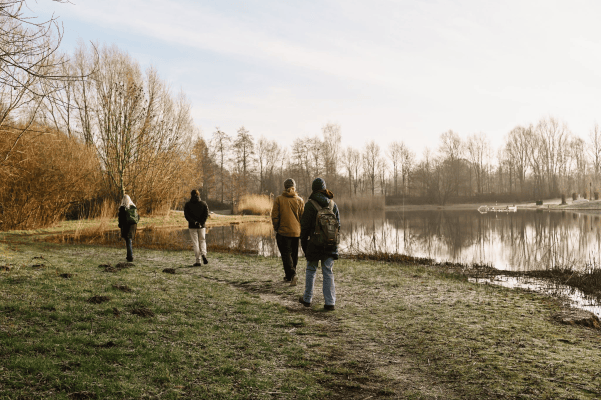
To process this bit of theory, we walked in pairs and discussed our own personal responses to world news and how we let it effect our daily lives. We ended our session by making a small artwork of little natural things we picked up from our environment. Some sticks, flowers, pieces of moss, brown leaves and other things made a small reminder for our first session.